


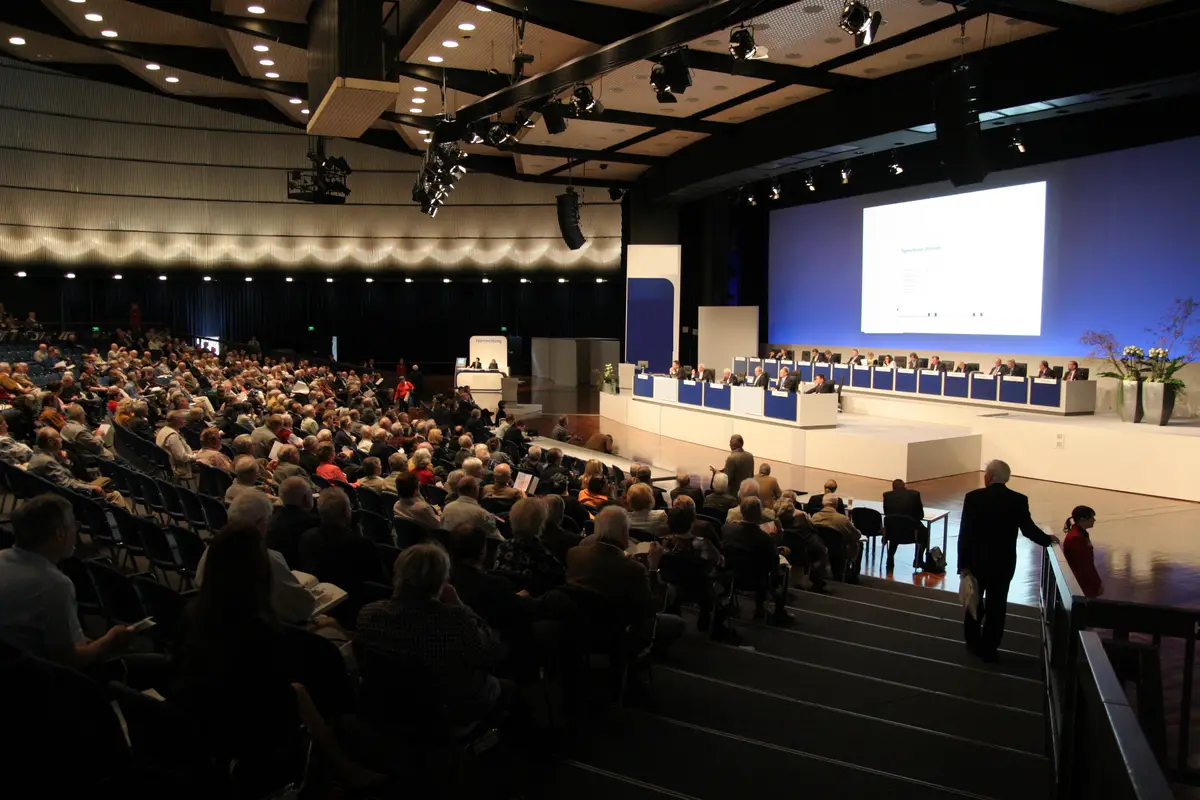


Annual general meeting software
for shareholders.
An annual general meeting is the yearly meeting of a company's shareholders or an organization's members. AirLST keeps the invitation, registration with proxies, admission ticket and check-in on one record, so the attendance list is documented, not estimated.
- Invitation with shareholder number
- Proxy at registration
- Attendance recorded by scan
What an annual general meeting demands from the organizing team
When the chair announces who is present, the number has to be right. Not roughly right.
Shareholders, members or partners expect an invitation that reaches them, a registration that knows their proxy, and an entrance that does not hold them up. The minutes expect an attendance list that shows who was there and when. In AirLST, both come from the same record.
The chain of deadlines from notice to attendance list
Between the notice of meeting and the count at the door lie deadlines, eligibility checks and proxies. Which ones apply is set by your bylaws and the law. That they were met is visible on the attendee record: with a timestamp, not from memory.
Shareholder no. 10611 · Shareholder
Notice periods, formal requirements and voting rights follow your bylaws and the applicable law. AirLST maps them as fields and timestamps and does not replace legal advice.
Every role sees what it needs.
Corporate secretary
Sees every step from sending to attendance.
- Invitation with shareholder number
- Registrations live
- Attendance per hall
Attendees
Register and appoint a proxy if needed.
- Registration with shareholder number
- Proxy and plus-one
- Admission ticket by email
Records
See who changed what on the record, and when.
- Change log
- Roles and permissions
- Attendance reporting
Admission
Scans the admission ticket and sees the proxy right away.
- Valid once
- Proxy shown with the shareholder
- Live attendance
AGM invitations with a personal registration link
The invitation goes to the defined list of attendees, in your design, from your sender address, with a shareholder or member number. The link leads to registration: attend in person, appoint a proxy or decline. Every reply lands on the record with a timestamp.
- Closed list of attendeesOnly people on the list receive a link. No open registration page, no forwarding.
- Proxy as a fieldThe proxy's name and contact details sit on the invitee's record; the proxy receives a separate admission ticket.
- Timestamp per replyRegistration, change and decline are logged with date and time, including against the registration deadline.
- Your sender, your designTemplates in invitation management, sent from your address, reminders as a workflow.
- Groups with their own pathShareholders, management, board, press, guests: a separate invitation, separate fields and separate permissions per group.
- Eligibility as fieldsRecord date, proof of holding, delegate status: whatever your bylaws require becomes a field, as an upload or a checkbox.
- Capacities includedHall or area capacity as a quota; the waitlist keeps track of who moves up.
- Replies without retypingAttendance, proxy, plus-one: entered through the personal link, straight onto the record.
The AGM attendee list before meeting day
Who has registered, who is sending a proxy, who has not replied yet? The list answers it for every attendee, filtered by status, group and deadline, with a log of who changed what and when.
| Attendee | No. | Status | Admission ticket |
|---|---|---|---|
| ABAnna Brooks | 10482 | Confirmed | TQ4LM8XA |
| DSDavid Shaw | 10611 | Confirmed | E27TGE1Q |
| LHLaura Hayes | 10097 | Invited | Reminder May 12 |
| TLTom Lee | 10903 | Confirmed | AIJOK0DG |
| SRSofia Romano | 10344 | Declined | – |
| CVChloe Vance | 10120 | Waitlist | Hall quota |
Everyone who has not replied by the deadline is a filter. The workflow sends the reminder, not your team.
Meeting chair, admission, notary: each role sees its own columns. Every change is logged with the person who made it.
The event CRM knows the history: who was represented last year, who never shows up, who always registers early.

AGM check-in by scan
Attendance confirmed. Not estimated.
One scan, and the door team knows: eligible, in person or as a proxy, with or without a plus-one, not inside yet. The check-in is stored on the record with time and station, and the meeting chair sees attendance live.
- Is this person eligible? Valid admission ticket, registered on time, code not used yet.
- In person or by proxy? The proxy appears on screen together with the shareholder they represent, not on a slip of paper.
- Which group? Shareholder, board, press, guest: on the record, with the area they are allowed into.
- How many are present? Live attendance for every station and the meeting chair, exportable as a list at any time.
Roles and permissions control what the door team sees and can change. Scanners, badge printing and on-site staff come with event access control.
Invitation, registration, admission and attendance list work on the same attendee
That is why nobody reconciles the invitation list, the registrations and the attendance count. What the project lead sees at the deadline is what the meeting chair sees on the day.
After the meeting, event reporting shows attendance, the share of proxies and no-shows. Contacts stay in the event CRM for next year's invitation.
Shareholder, member and partner meetings
Corporation, cooperative, association, trade body, chamber of commerce: different legal forms, the same requirement. A defined list of attendees, deadlines, proxies and documented attendance.






The Ulm Chamber of Industry and Commerce (IHK Ulm) lets 900 attendees of its graduation ceremony manage their own plus-ones and details; 900 check-ins run through the scan at the entrance. More projects under customers, and the industry view under financial services.
What your AGM organization has afterwards
On the record for the minutes. Calm for the team.
- 01One list from invitation to attendanceInvitation list, registrations and attendance read the same record. Nothing needs reconciling, because nothing drifts apart.
- 02Deadlines with timestampsRegistration, change, proxy: every reply is logged with date and time.
- 03Proxies in plain sightProxy and represented shareholder are linked, at the door and on the attendance list.
- 04Admission without a lineScan instead of search, several stations on one list, live attendance for the meeting chair.
- 05Data protection in placeHosted in Germany, roles and permissions, change log. Details in the Trust Center.

Who is in the room counts. And is on record.
What is an annual general meeting?
An annual general meeting (AGM) is the yearly meeting of a company's shareholders or an organization's members, where the matters assigned to it by the bylaws and the law are decided: approving the accounts, discharging management, electing directors or board members, deciding how profits are used, amending the bylaws. Corporations often call it the annual meeting of shareholders or stockholders; associations, trade bodies and cooperatives call it the annual members' meeting.
Its purpose is accountability: management reports to the owners or members, and they vote on the decisions reserved for them. In organizational terms, every form has three things in common. The list of eligible attendees is fixed before invitations go out, deadlines have to be met, and attendance has to be documented, because it determines the quorum and the majorities. These three properties set an AGM apart from an open event and define what attendee management has to deliver.
The list of attendees is fixed before anyone is invited. That is what sets an AGM apart from every other event.
How does an annual general meeting run in AirLST?
The process has five steps, all on the same attendee record:
- Build the list. Import from the share register, member database or Excel into the guest list, with shareholder or member number and group (shareholders, board, press, guests).
- Invite. A personalized invitation from invitation management in your design, from your sender address, with a personal registration link; deadlines as part of the template, reminders as a workflow.
- Register. The invitee chooses to attend in person, through a proxy or by proxy form, and adds plus-ones and notes; every reply carries a timestamp. The admission ticket goes out automatically with the confirmation.
- Admit. The check-in app scans the admission ticket, recognizes proxies and plus-ones, and records attendance with time and station. Several stations work on the same list.
- Document. Attendance list and proxies as an export for the minutes and, where one is involved, the notary; attendance and no-shows in event reporting.
Which data and building blocks does an AGM need?
For each attendee, at least: name and contact details, shareholder or member number, group, invitation and registration status with timestamps, type of attendance (in person, proxy, proxy form) with the proxy's details, plus-one, any eligibility proof your bylaws require, and the check-in time. Depending on the legal form, number of votes, shares held or delegate status are added as custom fields.
The building blocks for this are standard in AirLST: guest list with custom fields and filters, invitation management with templates and your own sender, event registration with conditional logic, event ticketing with QR codes that can be used only once, a check-in app with live attendance, roles and permissions, a change log and event reporting. Anything beyond that, such as an access link for online attendance, is a configuration of the same building blocks.
Which formats does it fit?
Any meeting with a defined list of attendees and documented attendance: the annual shareholder meeting of a corporation, the annual members' meeting of an association, trade body or chamber, the general meeting of a cooperative, the partners' meeting of a privately held company, the delegate assembly of an umbrella organization. Employee meetings and owners' meetings follow the same pattern, as do special general meetings between AGMs.
- Financial services: banks, insurers and cooperatives with high requirements for proof and data protection
- Public sector (Europe): members' meetings of chambers and trade bodies with a scanned attendance list
- Corporate events: partner and employee meetings within a group of companies
- Conferences: when the meeting is part of a multi-day program
Which notice periods apply to an AGM invitation?
The notice period comes from the law and your bylaws, not from the software. It differs by country, state and legal form; corporations, associations and cooperatives each have their own rules for the notice of meeting, the record date and the registration deadline. The same applies to the question of when the AGM is due each year. What AirLST provides is proof: the send date for each invitation, a timestamp for each registration, the registration deadline as a hard limit in the form, and reminders to everyone who has not replied before the deadline. Whether a deadline was met can be read from the log. This does not replace legal advice; clarify the deadlines themselves with your legal team or counsel.
Can an annual general meeting be virtual or hybrid?
Whether a meeting may be held as a virtual shareholder meeting or in hybrid form is set by the law and your bylaws. For attendee management, little changes: the list of attendees, the invitation, registration with proxies and the timestamp stay the same. Instead of an admission ticket, a shareholder or member attending online receives a personal access link from the same registration; people in the hall are scanned, people online are counted at the access link. Both appear on the same attendance list.
Streaming and questions from the floor run on the meeting technology meant for that; AirLST gives it the eligible attendees and takes attendance back. For votes, AirLST offers its own online voting with for, against and abstain.
Questions about annual general meetings with AirLST
What is the difference between an AGM and a general meeting?
How are proxies recorded when shareholders or members register?
Can anyone attend a shareholder meeting in person?
How does AirLST document attendance for the minutes?
Can the AGM invitation go out in our own design and from our own address?
How is shareholder and member data protected?
Image credits: Photo: Armin Kübelbeck, Wikimedia Commons, CC BY-SA 3.0, edited · Photo: Denis Schröder (WMDE), Wikimedia Commons, CC BY-SA 4.0, edited